

Pareidolia is a psychological phenomenon in which the brain assigns a practical meaning to an external object (a picture or sound). As an artist, I can say that in life, I inevitably imagine and then reassemble what I see. This work is the process of rearranging and reorganizing my memory. From right to left which are: my memory and association with the sea, my belief and love of the land, also my respect and imagination of the sky. As a child growing up in an environment that combines Chinese and Western cultures, Chinese and Western cultures are harmoniously intertwined, and memories of both are superimposed on each other. This painting is to present my thoughts on the superimposition of Chinese and Western memories.
PAREIDOLIA
Pareidolia is a phenomenon in which people tend to imagine things, such as fish, trees, mountains, and other things as familiar things at a certain moment. This response has evolved through natural selection and is more of a subconscious intuition or imagination. These also cna be called "hidden messages" and always appear quietly around people as they grow up.

This may be a subconscious retention of past memories. Because time and environment change too fast, I force myself to adapt to the environment, but my brain wants to retain the emotions from my memory, such as the caution when I first painted a detailed building, the pride when I persuaded my parents to buy me the toy that I wanted, or the time when my relatives who have passed away accompany me. These are all part of who I am, and my roots. I could not abandon my roots, so when I left my hometown, I kept looking for the familiar sense to make myself feel comfortable in the present environment.

Inspiration & intention

When I was a child, I was always deeply influenced by the architecture and people of my hometown, so when I grow up, I will still look for the sense of the architecture of my hometown from the environment around me. For example, I might think of a cloud as a bridge and water in my hometown, or I might imagine a piece of bread as a childhood toy.

Process
When choosing the materials, I wanted to present a classical Chinese painting style. Therefore I decided to use pigments made from ore. This helps to give the picture a classical color and the rougher particles give it a more rustic look, which allows me to present the ‘land’ part better.
In addition, I also want to present the change of ‘I’ through the combination of Chinese and Western images. Therefore, I chose the ancient Chinese medium, silk, as the medium.

I used the Chinese painting techniques of ‘space’ and ‘outlining’ to make the main body of the picture. This is my study and presentation of classical Chinese painting.

Originally, I was going to draw some random buildings, but then I decided that I wanted to accentuate my idea of ‘memory overlay’. I combined the memories of the river cam that I saw when I was a child in Cambridge with the architecture of my hometown in an ancient Chinese town. Therefore, this combines Chinese and Western architecture. Look closely, it shows European-style churches and castles, but also Chinese-style bridges and short houses in the Jiangnan water town. This is a reflection of ‘me’, I grew up in an environment that combines the East and the West, so in my opinion, there is no special distinction between architecture and environment, all things are integrated together. This painting is a reflection of the artist and the memory.

Here, I used the technique of ‘rendering’ from classical Chinese painting to create the texture of ‘water’. It makes the fins of the fish look more ethereal and free. Originally I wanted to draw the fish with outlines here, but then I wanted to contrast it with the other outlines, so I chose the rendering technique to blur the texture. This allows for a clearer contrasting image, which adds to the deeper layering of the image.


After the overall structure was laid out, I realized that there were some sections with obvious gaps, so I started thinking about how to fill these gaps. Considering the coherence of the whole picture, I need to add some transitions to these gaps. Now the whole picture is too ‘solid’, I need to add some ‘imaginary’ things in the picture to balance the lightness and weight of the picture. Also presents the way and rhythm of classical Chinese painting.

The last step was the one that changed the style of the whole painting. When I finished the painting as a whole, I realized that all the images were still too scattered and not complete enough. So, I thought about the special characteristics of the silk medium, which is, I could splash a lot of water on it, but it would not affect the clarity of the outline, and it would not crack when it touched water like paper.
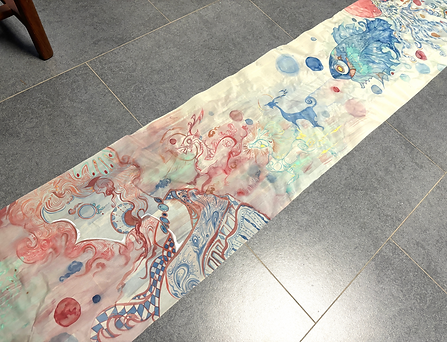
So I immediately turned the silk on its side, splashed water on the reverse side, and then ‘dyed’ the fabric with a large brush.
Final Work


Felisa Gan
PAREIDOLIA
Silk, mineral pigment, gold foil
500cm x 40cm
2024
The intention of this work is to present people's search for the past. Pareidolia is a psychological phenomenon, which people will subconsciously attach their past memories to new things. When people don’t want to left the past, so they will use past memories to increase their security when facing new circumstances. Silk as classical Chinese material, which present the theme of "roots" and "nostalgia". This is to convey to the audience the idea of "memories shape the present".